.png)


West Perth Altona 22 Office
22 Altona Street, West Perth is a single-storey building constructed in 1965 on a 650m² site in West Perth. The property was originally used as offices and was approved for conversion to a single house in January 2025.
For many years the building was occupied by the Architects Board of Western Australia and the Committee of Architectural Education. The property was formerly owned by the Royal Australian Institute of Architects (RAIA) before being sold to Majicyl Pty Ltd on 23 March 2007 for $3,861,000.
Following the purchase, the property was periodically offered to the market. It was listed for lease in May 2008, December 2010, March 2015, July 2016 and June 2023.
The site has been the subject of two redevelopment proposals. On 9 March 2010, the City of Perth conditionally approved demolition of the existing office building and construction of a ten-level mixed-use development. The project did not proceed.
In 2018, Urbanista Town Planning lodged a development application seeking approval to demolish the existing building and construct a nine-level residential development valued at approximately $6.2 million. The proposal comprised 23 apartments and 27 car parking bays, including a one-bedroom apartment, twenty two-bedroom apartments and two three-bedroom apartments. The development was never constructed.
On 5 June 2024, the City of Perth inspected the property and found it was being used for residential accommodation despite only being approved for office use. Council officers determined the building was being occupied as either a residence or a form of lodging house accommodating more than six people. An enforcement notice and Emergency Building Order were subsequently issued requiring the property to be vacated within 14 days and restricting its use to its approved Class 5 office classification.
A development application seeking approval to change the use from office to single house was subsequently lodged and approved on 7 January 2025.
Majicyl Pty Ltd remains the owner of the property and owns more than 100 properties across metropolitan Perth, including numerous residential properties in Hocking and Madeley.
June 2024


West Perth 5 Colin Street
The building at 5 Colin Street, West Perth, known as Amity, has very little documented history available.
It does not have an individual heritage listing, nor does it appear in either the City of Perth's Local Heritage Survey or the State Government's inHerit database, which often include places that are not necessarily heritage protected.
The property also appears to have conflicting or inaccurate historical information recorded against it, which, together with the lack of readily available information, was a key motivation for researching the site.
Malvern Flats
The existing building was constructed between 1917 and 1918, then located at 7 Colin Street and was originally known as Malvern Flats. At some point, the street numbering changed and the property became known as 5 Colin Street.
Amity
Today, the building is known as Amity and comprises 12 individually owned strata lots. The entire property occupies a site of approximately 931m², with individual units ranging from approximately 55 to 74 m². The origin of the name Amity has not been identified.
Historical records indicate the site was previously occupied by a substantial residence constructed around 1912-1913, which was demolished in 1917 to make way for Malvern Flats.
The property was occupied by a number of prominent residents during its early years, particularly former Fremantle mayor and merchant Edward Henry Fothergill and his family.
Early history
In January 1911, auctioneer Charles Sommers advertised the sale of superior household furniture on behalf of Wilfred Faulkner Wilkinson at his residence, No. 7 Colin Street, described as being located "off Colin Grove" on the King's Park side of West Perth.
The Wise Directory lists Wilkinson's residence as being located at 7 Colin Grove, which appears to have occupied the rear portion of the 7 Colin Street property at a time when no building had yet been constructed fronting Colin Street.
The sale included an upright grand piano, drawing room suite, bedroom furniture, an oak sideboard and other high-quality furnishings, suggesting the property was a substantial family home.
The Colin Grove house appears to have been demolished later in 1911, with a new residence constructed around 1912-1913. Occupied by William Clements between 1913 and 1916, this building was subsequently replaced in 1917 to make way for Malvern Flats, which was completed in 1918.
Henry Regia Hallett
Between 1918 and 1922, Henry Regia Hallett was associated with the property.
Born in Winnininnie, South Australia, in 1870, Henry married Sophia Amelia Grange in Broken Hill, New South Wales, in 1892. The couple later moved to Western Australia, where they were said to have accumulated considerable wealth supplying water to a remote desert location that was miles from any other source.
By 1897, Henry was operating a bakery in Cue in partnership with William Leyshon and a year later, the pair had also established or acquired a dairy business.
Sometime afterwards, the family moved to Geraldton where Henry operated a dairying business on Chapman Road. He was also a director of the Victoria Co-operative Flour Mill and owned a wheat farm at Oakabella, north of Geraldton.
After his health began to deteriorate, he was forced to give up the business and moved to West Perth, where he resided at 7 Colin Street, before later relocating to 101 Colin Street. He died there on 17 June 1925 at the age of 55.
An auction was held in June 1922 to dispose of surplus oak furniture and furnishings on instructions from Edward Fothergill, including Axminster carpets, Indian rugs, bedroom suites, garden tools and other household items. As the Fothergills appear to have taken up occupancy shortly afterwards, it is possible these furnishings originated from Henry Hallett's period of occupancy, however this has not been confirmed.
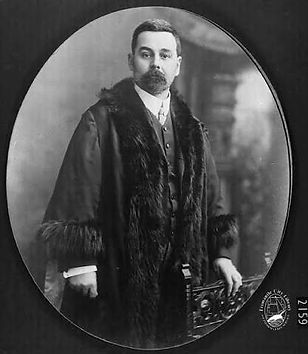
Edward Henry Fothergill (Jnr)
Fothergill family
From 1923 to 1940, Edward Henry Fothergill (1871-1941) and his wife Gertrude Jane Fothergill were associated with the building.
Fothergill was a prominent Fremantle businessman, public official and community figure. Born in Melbourne, he moved to Western Australia with his family at the age of nine and was educated in Fremantle. He was the son of Captain Edward Henry Fothergill, an English-born shipping merchant who operated one of the few regular trading links between Victoria and Western Australia during the colony's early years.
At the age of 17, Fothergill began working for drapers D. & W. Murray before later managing the Western Australian Lighterage and Stevedoring Company. After the opening of Fremantle Inner Harbour led to the company's closure, he established his own business in 1901, E. H. Fothergill & Co. Ltd, where he served as Managing Director.
He served on the Fremantle Municipal Council, occupying the mayoral chair between 1909 and 1910 before returning as a councillor between 1920 and 1923, and was appointed a Justice of the Peace in 1904. He was also a member of the Tramways Board and involved in charitable organisations, including serving as Honorary Secretary of the Fremantle Hospital Aid and Charity Committee.
Gertrude was involved with the Girl Guides State Executive Committee. The couple married in 1911, with Gertrude being the daughter of William Meadly of North Fremantle.
Newspaper advertisements provide small glimpses into everyday life at the property.
Gertrude advertised for a girl in 1924 to help care for her children, a nursegirl in 1925 and again advertised for a competent housekeeper in October 1927.
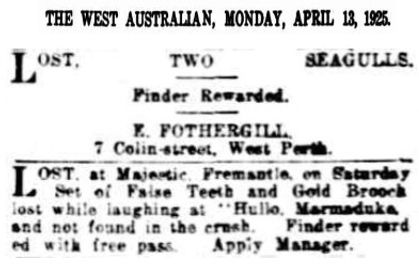
Maybe Edward wanted the seagull poo to make guano for explosives or gunpowder. He'd surely have to know what he was doing, otherwise it could have all backfired.
The advertisement underneath has also been included, serving as a timeless public service reminder of what can happen when one laughs while wearing false teeth!
On 1 January 1930, nine-year-old Edward Fothergill was seriously injured after being run over by a car at approximately 7.30 pm. He had jumped from the spare wheel mounted on the back of a moving vehicle he had been riding on when he was struck by another car. He suffered a fractured leg and multiple abrasions.
Edward Henry Fothergill died on 25 May 1941 at the age of 69. Probate notices relating to his estate were published in 1943.
Residents
Following Fothergill’s death, Malvern Flats was occupied by numerous tenants throughout the 1940s and early 1950s, including:
-
Miss M. Porter (1941-1945)
-
William Tonkin (1941-1945)
-
Marr (1941-1942)
-
Cedric John Paterson (1941-1945)
-
Kennedy (1941-1942)
-
Mrs Cooper (1944-1945)
-
Mrs Helmrick (1944-1945)
-
Mrs Palmer (1944-1945)
-
Crawford (1944-1945)
-
L. Johnson (medical practice) (1944-1945)
-
Drummond (1946-1949+)
-
Mrs Joyce Walker (1946-1947)
-
Mrs Hilda Joyce Newton (1946-1952)
-
Ailsa and John Tanner (1946-1949+)
-
Mrs Lillian Hiller (1946-1947)
-
Mrs Jean Haynes (1946-1947)
-
Mrs Bennett (1947)
-
R. J. Carne (1949+)
-
Mrs T. Gribble (1949+)
-
Thomas Keith Magee (1949+)
-
Mrs James (1949+)
-
Mrs Keith (1949+)
On 14 July 1951, Malvern Flats, which appears to have comprised of ten flats at the time, was advertised for sale for £24,000.
Later occupants
By 1965, Beatrice Elizabeth Hefner was residing at 5 Colin Street when she was granted a Certificate of Naturalisation.
In July 1976, Henrietta Leome Bieleski was residing at Unit 8 when she appeared in citizenship records.
By November 1986, N. C. Read Pty Ltd was operating from Unit 1 under principal Nancy Christina Read. The business specialised in export marketing consultancy, seafood trading and fisheries consultancy services relating to prawns, lobster and abalone.
On 23 May 1995, a company meeting was held at Unit 12 where members of Chiyotama Pty Ltd passed a special resolution to voluntarily wind up the company and distribute its assets, in whole or in part, to members in specie if desired by the liquidators.
Structural upgrades
Recent development applications indicate ongoing works to the building.
In June 2025, approval was granted for the replacement of existing timber staircases with steel staircases servicing all 12 units.
In August 2025, approval was granted for floor strengthening works to the existing office building.
A further development application was lodged in May 2026 for structural modifications to existing staircases and barriers.
June 2024


West Perth 678 Murray Street
678 Murray Street, West Perth, known as Nobel House, is a substantial commercial property occupying a 3,803m² site at the corner of Murray and Havelock Streets. The existing building was constructed during the late 1950s and contains approximately 2,548m² of floor space.
Although appearing as a single complex, aerial imagery indicates the development was constructed as two interconnected buildings. The Murray Street frontage contains the office and showroom component, while the Havelock Street side was built in the form typically associated with a small factory, workshop or manufacturing operation.
Ownership
The property was later owned by Golan Industries Pty Ltd and Carmel Custodians Pty Ltd, two closely associated companies that were both incorporated on 23 February 1973.
The origins of 678 Murray Street is difficult to ascertain, largely due to very little information being publicly available. Because the building predates both Golan Industries and Carmel Custodians by around 15 years, neither company is believed to have constructed it. The property remained in their ownership until 1 June 1995, when it was sold for approximately $1.3 million to Nobel Investments Pty Ltd.
Nobel Investments
Nobel Investments Pty Ltd had only been incorporated a few weeks earlier on 18 April 1995. The company later became known for its ownership of the Albany Woollen Mills, which it acquired in 1996 with the assistance of a State Government support package aimed at preserving more than 100 regional jobs. The package included a $2.8 million interest-free loan that could be converted into a grant if employment and performance targets were met, as well as payroll tax concessions and funding for sewerage infrastructure. Despite meeting a number of the required milestones, the renamed Albany Spinning Mills ceased operations in 2001 following a period of financial difficulties. Factors cited at the time included rising transport costs, increased wool prices, the Asian economic crisis, the introduction of the GST, the collapse of HIH Insurance and competition from alternative flooring products.
Tenants
The property continued to operate as a multi-tenanted commercial office building under Nobel Investments' ownership. By 2022, the first floor was occupied by Intelligent Monitoring Group Limited, an Australian security and monitoring technology company. Current tenants include Tactical Conflict Solutions Pty Ltd, Threat Protect Australia Limited, which forms part of Intelligent Monitoring Group, and VIP Security Industries Pty Ltd.
Listed for sale
Since late 2025, 678 Murray Street and the neighbouring property at 84 Havelock Street have been offered for sale as development sites, although prospective purchasers have been given the option of acquiring either property individually or both together. Nobel Investments also owns a number of other properties, including the former Albany Spinning Mills and several residential properties.
2024 - 2025


