


Crawley Catalina Flying Boat Base
3. The WWII flying boat base
Establishment of the American base
The United States Navy established a seaplane base at Crawley Bay in March 1942, known as Pelican Point Advance Base “A”, or “Able”. The aircraft belonged to Patrol Wing 10, which had withdrawn from the Philippines and the Netherlands East Indies as Japanese forces advanced through the region.
Its aircraft undertook reconnaissance, anti-submarine patrols, convoy escorts, search and rescue, and occasional bombing missions. Operations extended across the Indian Ocean and towards the Netherlands East Indies, now Indonesia.
Historian Lindsay Peet identified Crawley as both a training and local patrol base. Drawing on the wing’s war diary, he listed VP-101, VP-11, VP-33, VP-34 and VP-52 among the squadrons that operated there.

022802PD RAAF Catalina on the Swan River, 1944-1945
Military use of the foreshore
The Commonwealth Government requisitioned the foreshore reserve for defence purposes. The American base occupied land around the present Mounts Bay Sailing Club and Royal Perth Yacht Club sites. A separate Australian facility was established west of Pelican Point, in the area now associated with the Qantas ramp.
The American facilities included a launching ramp, hangars and an aircraft servicing area. Existing foreshore buildings were also used. A later Department of Conservation and Land Management account recorded that military pipelines, sewerage and electrical systems influenced the location of some subsequent facilities, including ablution blocks.
Surface vessels supported the flying operations. The departmental account includes an eyewitness description of patrol boats clearing floating debris ahead of Catalina take-offs.
University buildings and accommodation
In March 1942, Western Area Headquarters reported that 120 US Navy air personnel were camped at the university, with another 150 and their equipment expected any day. (RAAF Western Area Headquarters to Air Board, secret cypher message GR 152, Air Board NR 62, enclosure 22).
The university boatshed became the American headquarters. Officers’ accommodation was constructed north of Stirling Highway on the site now occupied by University Hall, formerly Currie Hall.
A photographic laboratory processing aerial reconnaissance photographs occupied a substantial part of the Engineering Building, now the Guild Tavern. Riley Oval was sometimes used as a parade ground, and Quonset huts were erected around the campus. UWA’s historical account also records that the red terracotta roofs of Winthrop and Hackett halls helped pilots identify the base from the air.

196556PD Geophysical Services International office, Broome, Western Australia, 1957.
Quonset Hut was the office and sleeping quarters, the green hut was the toilet
An account in University Voices: Traces from the Past describes prefabricated buildings beside St George’s College and tight security around the university precinct. Barbed-wire fencing restricted public access and permits were required to move through the area. University staff invited to the officers’ mess recalled the quantity and variety of food available (Shervington, 1987, pp. 42–43).
Aircraft and personnel
UWA’s historical account gives approximate figures of 60 to 70 Catalina flying boats and 1,200 American naval and support personnel associated with the base. It doesn’t establish that all were present at the same time.
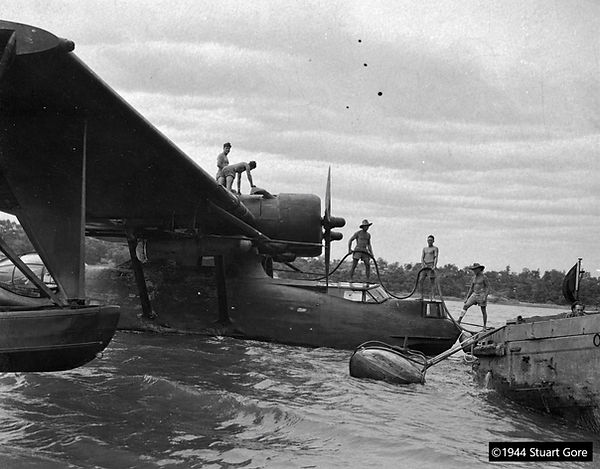
022809PD: Refuelling RAAF Catalina flying boat on the Swan River, 1944-1945
The account in University Voices describes Catalinas refuelling at the end of Crawley Avenue between 4 am and 6 am before departing on long flights and returning in the evening. Aircraft also practised landings on the Swan River, passing close to the University tower (Shervington, 1987, pp. 42–43).
Defence of the base
The flying boat base received anti-aircraft protection. Following the return of the 2/3rd Australian Light Anti-Aircraft Regiment from the Middle East in 1942, its units were deployed to several locations in Western Australia.
The regiment’s history records that one troop of its 8th Battery was stationed at the Catalina base at Crawley Bay.
Personnel from the 107th Australian Tank Attack Regiment were also seconded to the 660th Light Anti-Aircraft Battery at Crawley Bay with heavy machine guns to strengthen the base’s anti-aircraft defences. Six additional Bofors guns were installed and manned at night by members of the Volunteer Defence Corps (VDC).
Qantas and the Double Sunrise service
Qantas operated a separate Catalina service from the Swan River to Lake Koggala in Ceylon, now Sri Lanka. The flights restored an air connection towards Britain after the fall of Singapore had severed the previous route.

86B-2 - QANTAS Catalina taking off from the Swan River, part of the Double Sunrise Catalina Service from Nedlands to Ceylon, Western Australia, 1943.
The RAAF’s history dates the first departure from Perth to 29 June 1943. The service became known as the Double Sunrise because the long flights could keep passengers and crew airborne through two sunrises. Aircraft maintained radio silence and navigation relied on observations of the stars.
Five Catalinas were used for the service. Non-essential equipment was removed and additional fuel capacity installed for the crossing. The aircraft carried small numbers of passengers, mail and priority cargo.
The RAAF supplied experienced personnel, training, engine maintenance and weather forecasting support. Its account records that navigators and pilots were seconded to Qantas, while Catalina engines were overhauled at No. 4 Aircraft Depot’s workshops at Boulder.
The service completed 271 Indian Ocean crossings and ended in July 1945, with the final flight arriving in Perth on 18 July.
Moorings and exposed conditions
Correspondence between the Department of Air and its works officers records difficulties with the flying boat moorings.
In January 1944, a request was made to move a buoy anchored opposite the Qantas hangar, about 150 yards east-southeast of Nedlands Jetty. The proposed position was approximately 1,000 feet northeast, beside the recently constructed Civil Aviation slip used by Qantas.
The works office considered both positions unsuitable for RAAF use because of their exposure. It reported that Civil Aviation and Qantas representatives appeared to have selected the proposed position during calm weather (Department of Air, No. 6 Divisional Works Office, Memorandum 24/8/280).
By May 1944, attempts to lift the existing anchor block had failed because it was buried in 12 feet of mud. Approval was given to use a replacement block at the new position (Department of Air, No. 6 Divisional Works Office, Correspondence 29/8/Perth 3).
A September 1944 report recorded that four Sunderland-type buoys previously loaned to the US Navy air wing had been removed. Two remained opposite Nedlands Jetty for Qantas use, while another was anchored off the US Navy hangars. Four Seagull-type buoys were also located at the hangar anchorage (Directorate of Works and Buildings, Correspondence 24/8 Perth 3).

Cutaway diagram of a Consolidated Catalina flying boat, showing its internal structure, crew compartments, engines and retractable wing floats. Aircraft of this design operated from Crawley Bay during the Second World War. Drawing by J. H. Clark, published in The Aeroplane.
American withdrawal
The American operations ended in stages. An Allied Works Council memorandum dated 10 January 1945 records that the Navy’s flying boat section left Perth in early September 1944 (Allied Works Council, memorandum 24/08/280-57A, D.3012, 10 January 1945).
Peet reported that the utility training unit VS-61 continued into 1945 after Fleet Air Wing 10 departed. UWA records American use of university facilities until February 1945. The departure of the flying boat section therefore did not mark the end of all American activity at Crawley.
No. 82 Operational Base Unit
The RAAF’s No. 82 Operational Base Unit was established at No. 5 Personnel Depot in Subiaco on 12 September 1944. Its proposed move to Crawley Bay was initially delayed by difficulty securing buildings. The unit moved to temporary premises on Riverside Drive on 28 October and began operations on 1 November. It relocated to Crawley Bay on 13 November, where the university’s boatshed was quickly made operational.
The unit maintained visiting flying boats, operated marine craft and supported Qantas. In December 1944, work began on a bulk fuelling installation using existing underground tank piping. This allowed marine craft to refuel at Crawley instead of travelling to Riverside Drive. Aircraft moorings left by the US Navy Catalina squadron were lifted, inspected and repaired, with additional moorings installed during 1945.
Three RAAF Catalinas were based at the unit during February 1945, when two Royal Netherlands Navy Catalinas also visited. Dutch Catalinas returned in July for refuelling and servicing. The unit supplied flare paths for landings and early morning take-offs, while its workboats assisted Qantas when the company’s own boats were unserviceable.
By May 1945, the unit had approximately 50 personnel. A night-duty crew inspected marine craft and buoys and provided a full crew at 20 minutes’ notice to service aircraft. The unit also undertook major engine and hull repairs to marine craft serving elsewhere in Western Area.
After the war, Crawley continued receiving Catalinas carrying returning service personnel and some prisoners of war. Twenty-two aircraft arrived during October 1945, followed by five in November and eight in December. The unit arranged maintenance, refuelling, accommodation and rations.
Its launches also recovered torpedoes, supplied Rottnest Island and assisted with the disposal of bombs and ammunition at sea. In January 1946, launch 03-6 assisted with the demolition of two Catalinas nine miles west of Rottnest.
By April 1946, equipment checks were underway in preparation for closure and the unit’s marine craft had been allocated to No. 4 Transport and Movements Office upon disbandment. No. 82 Operational Base Unit was disbanded on 16 July 1946.

Diagram of a Catalina flight engineer’s instrument panel, showing engine instruments, fuel controls and switches. Revised 19 November 1941. National Archives of Australia: A705, 172/1/1186, Figure 8, p. 20.
The foreshore after military occupation
The wartime base introduced aircraft servicing facilities, accommodation and utility infrastructure to the Crawley foreshore. The records reviewed for this entry do not establish how much rubbish or debris remained after withdrawal, or provide an immediate postwar assessment of vegetation, erosion, water quality, birdlife or aquatic habitat.


