.png)


H1 Gun - 1.2in Mk IV Gun
Built in 1902 by the Royal Gun Factory, the two 9.2in MK IV guns destined for Oliver Hill, were delivered to Rottnest Island in 1937.
The Royal Gun Factory formed part of the Royal Arsenal in Woolwich, South London and is believed to have started production in 1716 with the construction of a foundry. They were previously called the Royal Brass Foundry, until they changed their name to the Royal Gun Factory in 1855. Collectively, they appear to be referred to as the Royal Arsenery, amongst a collection of other companies. All Royal Arsenal operations ceased to exist sometime in 1994.
1933
August 14 – Military experts recommend the Commonwealth Government to purchase a number of 9.2” guns to install in strategic locations around the country. It is being considered by Sir George Foster Pearce (1870-1952), Minister of Defence. Upon the budget being presented to the Federal Cabinet in September, a decision shall be made, due to an estimated cost of £5,000 per gun, with further costs of £25,000 for the gun mounting, special concrete foundation and associated equipment. At this stage, it appears that locations in Sydney, Newcastle and Fremantle are being considered for the guns (1)
1934
March - Sir George Foster Pearce, Minister of Defence, announces plans to purchase two 9.2 inch guns at a cost of £35,000 (2).
1935
September - Army Engineer Lieutenant Hussey is transferred from Sydney to the island to supervise construction work of the railway and early works on the island, which is being carried out by private contractors under the supervision of army personnel (2).


1936
Both 9.2 guns are relined and the breech mechanism is replaced with the latest model (3).
1937
February - The 9.2” H1 gun for Oliver Hill arrives in Fremantle Port on board the MW Wairangi with weighing 28 tons.
February 18 – The H1 gun is delivered to Rottnest (4).
1938
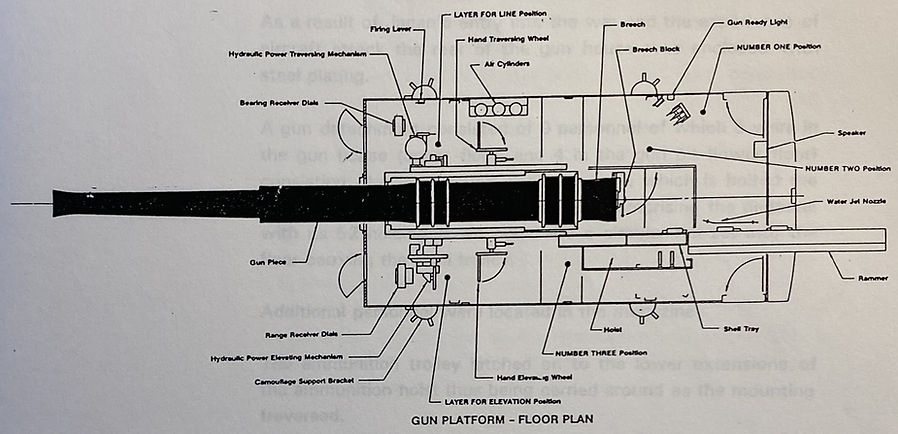
The 9.2” H1 gun barrel is installed on MK 7 mountings. It was originally supplied to the Royal Navy for use with Hong Kong’s fleet, before being transferred to the British Army in 1910 for use in defending the Portland Harbour.
November 21 – Both 9.2” guns are proofed.
In communications from the Commander of Coast Defences, it was stated that “the stone pitching on the upper surface of the apron at both emplacements were unable to resist the blast at elevations 7° and 0°. There were a considerable disturbance of the stone and it is considered that a layer of cement will be necessary” (5).
1939
Both 9.2” guns are fitted with fire control equipment and searchlights.
1940
June 23 - Rottnest Island is declared a prohibited place under National Security (General) Regulations (6).
July 16 – Relatives of troops stationed at Rottnest Island will now require passes to visit (6).
1941
December 8 – Japan declares war on USA and British Empire (6).
December 9 – Japan declares war on Finland, Romania and Hungary (6).
December – All women and children are subsequently evacuated from Rottnest Island (2).
1942
The Japanese are defeated in Battle of the Coral Sea and are subsequently denied an eastern approach to Australia (2).
The number of military personnel on Rottnest Island peaks at an approximate 2,500 (ibid).
November 2 – Operation Order No.18 orders that Oliver Hill and Bickley Batteries is to be manned as counter-bombardment batteries from dawn to sunset and as close defence batteries from sunset to sunrise (7).
1945
August 14 – Japan unconditionally surrenders and World War 2 ends.


1945
December – Rottnest Island is now open for tourism with renewed business leases for ferry and air services (2).
1946
July - The guns are placed in care and preservation (2).
1970
A team of army personnel recover the gun pieces and restore them (2).
1986
The No.1 gun is partially restored after the Rottnest Island Board receives a Commonwealth Bicentennial Grant of $60,000, 48 years after the guns were first proof fired and the Battery becoming operational. The work is carried out by the 5th Military District Workshop Company Royal Australian Electrical Mechanical Engineers amongst other voluntary groups (4)


References
(1) 9.2 Inch Batteries, Daily Mercury - 14 August 1933, p.10
(2) Oliver Hill Battery Rottnest Island: Conservation Management Plan. Completed on behalf of the Rottnest Island Authority by Palassis Architects (December 2005).
(3) Oliver Hill Battery - The Aiming Post - Edition 4-99
(4) Oliver Hill Battery Conservation Assessment for Rottnest Island Authority - GB Hill & Partners Pty Ltd (November 2005)
(5) NAA: K1214, 2/4/9 – 9.2 Equipment - Rottnest
(6) AWM52 4/18/5/1 - [Unit War Diaries, 1939-1945 War] CCD [Commander Coast Defences] Western Command, September 1939 - February 1942
(7) AWM52 4/19/7/5 - [Unit War Diaries, 1939-1945 War] Fremantle Fixed Defences, October - December 1942 (AWM2019.366.2949)
Tunnels
The entrance tunnel is in close proximity to the railway line, providing direct access for receiving supplies of cordite and shells for the magazine.
The tunnel leads to the Casualty Clearance Station, before providing access to the underground Magazine containing separate rooms for the Cordite and Shell Store (located under the concrete space behind the gun) as well as the extensive tunnel network.
All the below-ground structures (Pump Room, Shell Magazine, Cordite Magazine, Engine Room, Casualty Clearing Station and the connecting tunnels) were constructed in an open excavation area which was then subsequently filled with soil to cover them post-completion.
All structures were constructed with reinforced concrete with the roofs over the engine room, pump room and magazines being constructed with steel that was folded over and covered in concrete.


Hatches & Vents


Dummy Gun
Two mock guns and a dummy railway line made from old sleepers and lengths of four by two inch jarrah were constructed on the high features of both the Bickley and Oliver Hill batterys.


