.png)


Housing Estates: Are We Sacrificing Liveability for More Houses?

Take a drive through some of Perth’s newer housing estates and one thing becomes increasingly noticeable. Houses are being built closer together, backyards are becoming smaller, trees are disappearing and entire streets are being developed with very little natural shade.

In some estates, almost every available square metre of land appears to be occupied by a house, driveway, garage or paved area. What little outdoor space remains is often covered in artificial lawn, paving or decorative stones, leaving very little room for gardens, established trees or even a decent patch of grass.
While these developments provide much-needed housing for Perth’s growing population, there are questions about the long-term consequences of designing residential areas around fitting as many houses as possible onto the available land.
The disappearing backyard
For generations, the backyard was a familiar part of suburban life in Perth. Many older homes were built on blocks large enough to accommodate gardens, fruit trees, vegetable patches, sheds and outdoor areas where children could play.
There was room to entertain, grow plants, keep pets and enjoy some privacy from neighbouring properties.
In many newer estates, the traditional backyard has been reduced to a narrow strip of land between the house and the rear boundary fence. Some properties have little more than a small courtyard, while others have outdoor areas barely big enough to accommodate a table and chairs.
This raises questions about privacy, noise and whether these homes will continue to meet the needs of their occupants as families grow and circumstances change.
Not everyone wants or needs a large backyard and smaller properties can offer advantages, including less maintenance and potentially lower purchase costs. However, there is a difference between choosing a smaller outdoor space and having very little alternative because that is how entire suburbs are being developed.
The loss of trees and natural shade
Perhaps one of the most concerning features of some newer housing estates is the lack of trees.
Established trees are often removed when land is cleared for development, and the replacement landscaping can consist of small ornamental plants or young street trees that may take decades to provide substantial shade.
In some streets, there are no trees at all.

This is particularly concerning in Perth, where summer temperatures regularly exceed 35 degrees and heatwaves can bring several consecutive days of extreme heat.
Trees play an important role in keeping residential areas cooler. Their canopies provide shade to roads, footpaths, buildings and outdoor spaces, reducing the amount of heat absorbed by exposed surfaces.
They also release moisture into the atmosphere through a process called transpiration, which helps cool the surrounding air.
By comparison, concrete, brickwork, asphalt and paving absorb heat during the day and release it gradually after sunset. In areas with extensive hard surfaces and little vegetation, this contributes to what is known as the urban heat island effect.
Neighbourhoods can remain uncomfortably hot well into the evening, even after temperatures have started falling elsewhere.
The lack of shade also makes walking, cycling and spending time outdoors considerably less appealing during summer.
More than just shade
Trees provide benefits that extend well beyond reducing temperatures.
Their leaves can capture some airborne particles, while vegetation can help remove certain pollutants from the air. Trees also absorb carbon dioxide as they grow, provide habitat for birds and insects and contribute to the biodiversity of suburban environments.

Their roots help support soil structure, and vegetation can assist with absorbing rainfall and reducing surface runoff.
There are also the visual and psychological benefits of living among trees and greenery.
Compare an older suburban street lined with mature trees, gardens and established vegetation with a newly developed street dominated by roofs, garage doors, driveways and boundary fences.
The difference is considerable.
Trees soften the appearance of buildings, provide seasonal changes in colour and create a more pleasant environment for residents and visitors.
Research has also linked access to green spaces with benefits for mental health and general wellbeing, although these outcomes depend on factors such as the quality and accessibility of those spaces.
Artificial lawns and concrete landscapes
Another increasingly common feature of residential developments is artificial grass.
While artificial lawns are often promoted as a low-maintenance alternative to natural grass, they provide few of the environmental benefits associated with living vegetation.
Unlike natural lawns, artificial turf does not cool the surrounding environment through transpiration. It can also become extremely hot when exposed to direct sunlight, sometimes reaching surface temperatures considerably higher than natural grass.
Artificial turf also introduces plastic materials into outdoor environments and can contribute to waste and microplastic pollution as it deteriorates.

Particularly in a climate where water conservation is important, there are alternatives, including native gardens, drought-tolerant plants, mulched garden beds and appropriately selected shade trees.
Privacy and the changing suburban environment
The consequences of closely spaced housing are not limited to temperature and landscaping.
Privacy is another consideration.
In some developments, neighbouring houses are separated by narrow setbacks with windows, patios and outdoor living areas positioned close to adjoining properties.
Residents may find themselves keeping blinds closed or avoiding parts of their outdoor areas because of overlooking from neighbouring homes.
Noise can also become more noticeable when houses are positioned close together, particularly where outdoor entertaining areas, air-conditioning units and neighbouring windows are located within a few metres of one another.
These problems are not inevitable consequences of smaller blocks. Good building design, thoughtful window placement, landscaping and effective sound insulation can make a considerable difference.
Are we building houses or creating liveable suburbs?
Perth needs more housing and accommodating a growing population is an important part of planning for the future.
However, increasing the number of houses should not come at the expense of everything that makes a residential area comfortable and enjoyable.
Higher-density housing is not necessarily the problem. Well-designed developments can accommodate more residents while retaining trees, providing shared green spaces and maintaining reasonable privacy.
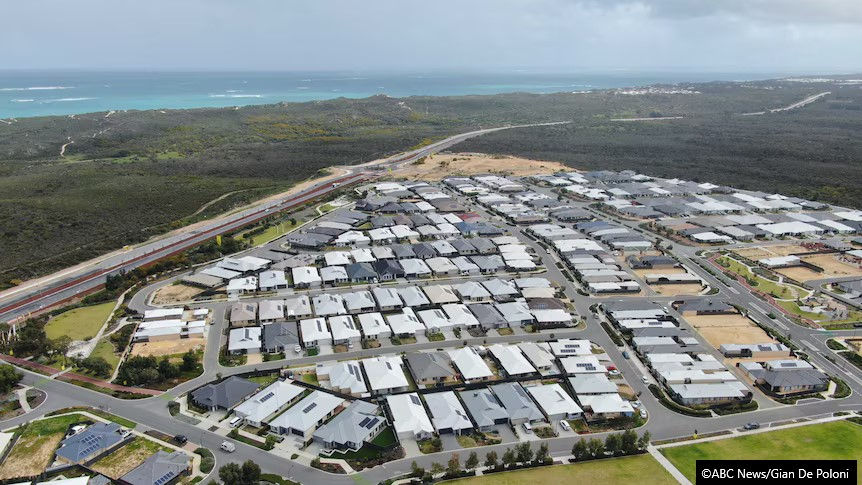
The difficulty arises when housing density increases without the landscaping, infrastructure and design standards needed to support it.
A small public park does not necessarily compensate for streets with little shade, particularly when residents need to walk along exposed footpaths during Perth’s summer heat to reach it.
Similarly, planting a handful of small trees along a street is not the same as preserving mature vegetation or allowing enough room for trees to grow to their full potential.
The amount of space available for planting is also important. Even where residents want to establish trees on their properties, narrow setbacks, underground services, boundary fences and limited soil space can make it difficult.
Once an estate has been developed, correcting these problems can be expensive or, in some cases, practically impossible.
What will these suburbs look like in 30 years?
One question worth considering is how today’s housing estates will function several decades from now.
Will the trees planted along their streets have enough space to mature, or will they eventually be removed because their roots interfere with paving, underground services or nearby buildings?
Will residents have sufficient outdoor space as their families grow?
Will the lack of natural shade make these neighbourhoods increasingly uncomfortable as Perth experiences more extreme heat?
And will future generations look back at these developments and question why so little room was allocated to trees, gardens and outdoor living?
Many of Perth’s older suburbs are valued today partly because of their established trees, larger gardens and leafy streets. These features did not appear overnight. They developed over decades, often because the original subdivision patterns provided enough space for them.
Some newer estates may never achieve the same level of vegetation because there is nowhere for substantial trees to grow.
That is a consequence of decisions being made during the planning and development stages, long before the first residents move in.
Planning beyond the next development
Housing affordability, population growth and the availability of residential land are genuine challenges. Larger blocks are not financially practical for everyone, and continuing to expand Perth’s suburban footprint also has environmental and infrastructure costs.
But these challenges should not be used to justify poor residential design.
There needs to be greater consideration of tree retention, meaningful planting space, privacy, building orientation, outdoor living areas and the amount of land covered by hard surfaces.
Developers, planning authorities and local governments all have roles in determining how residential neighbourhoods are designed and what standards they must meet.
Once the houses have been built, the responsibility for living with the consequences largely falls on the residents.
A successful housing estate should be measured by more than the number of properties constructed or how quickly the land is developed.
It should also be judged by how comfortable, practical and pleasant it is to live there, not just when the estate is new but decades into the future.
Because providing somewhere to live and creating somewhere people actually enjoy living are not necessarily the same thing.


Comments